Introducing: A Strategy for AI & Education
A blueprint for institutions that want to meet AI head-on, without asking students to trade their thinking for it.
We've just published something we've been building for a while: a full strategic blueprint for how educational institutions can approach artificial intelligence deliberately, instead of reactively. It's called A Strategy for AI & Education, and this piece is the short version: what's in it, why we built it this way, and who it's for.
The short answer to "why does this exist" is that most institutions are being asked to have an AI policy before anyone has given them a coherent way to think about what AI actually does to a learner's mind. So they either lock it out entirely, or let it in with no more structure than a chatbot window and a hope for the best. Neither is a strategy. Both are ways of avoiding the actual question.
It starts with a genuine tension, not a sales pitch
The blueprint opens where we think any honest conversation about AI in education has to start, with the real possibility that AI in the classroom quietly optimizes for the wrong thing. Not because anyone intends harm, but because efficiency and engagement are easy to measure and curiosity isn't. A system built to reduce friction will reduce friction, including the productive kind, the struggle that's actually how understanding gets built. Left unexamined, that's not education. It's a faster way to arrive at the same shallow place.
That's the challenge. The response we lay out isn't "reject AI." It's AI repositioned as a tool that operates inside an institution's own agency, governance, and control, rather than the institution operating inside whatever a vendor decided to ship.
Then it gets specific, with actual evidence
This is the part we're most glad we included, and most careful about how we framed it. The blueprint devotes real space to the MIT Media Lab's 2025 study on "cognitive debt," the EEG research showing that brain connectivity scaled down with how much AI support a writer used, and that 78% of habitual AI users couldn't quote a line from an essay they'd personally written minutes before.
We didn't want to cherry-pick the scary number and move on. So we went further into the same study and pulled out its most useful finding: when participants who'd written unaided were finally given AI access, their neural engagement spiked higher than anything the habitual-AI group ever produced. Timing, not exposure, was what moved the result. The paper's own conclusion is that AI should be introduced after self-driven effort, not instead of it, and that's the single idea the rest of the blueprint is built to operationalize.
From there we lay out three reframes we think matter more than the usual "AI good, AI bad" framing: scaffolding instead of offloading, neuroplastic enhancement instead of atrophy, and active metacognition instead of passive consumption. Each one turns out to hinge on something a piece of software can either be built to do or not, which is exactly why governance, not sentiment, is the lever that actually moves outcomes.
What governance looks like when it's not just a word
The blueprint gets concrete fast after that. We map four capability lines any serious AI-in-education engine needs: agentic governance over how and when AI activates, pattern analysis of real learning evidence, provenance and sources on every answer, and generative support for the reports and feedback that actually eat a teacher's week. Each one answers a specific finding from the research, not just a generic wish list.
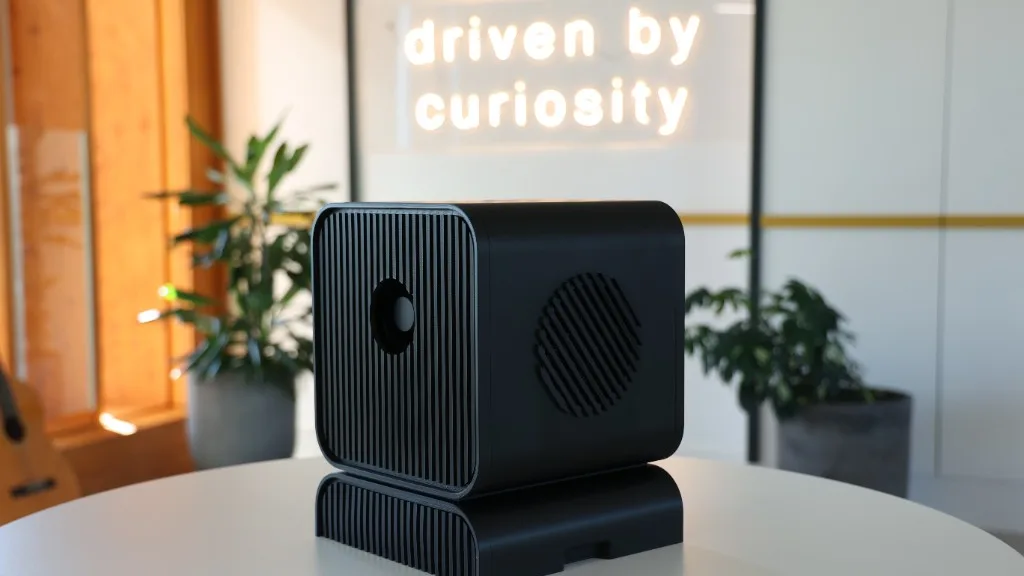
Underneath that sits the actual architecture: Empathy.AI Spaces running on a Local AI Workstation, with a reference design any institution's technical team can evaluate on its own terms: knowledge storage, retrieval, interchangeable reasoning engines, and a capacity model built for how a school, not a single user, actually works. We included the hardware and the economics deliberately, because "own your infrastructure" is a much smaller idea if nobody shows their work on what that costs and what it actually buys.

A Local AI Workstation an institution can own: the school holds the machine, and the machine holds the school's knowledge.
We didn't want to argue this in the abstract
So the blueprint includes three live examples, at different scales. Molly Vs The Machines shows the pattern in miniature: grounded retrieval plus a genuinely agentic document-generation feature, running today. Project Gutenberg AI shows the same architecture holding up across a genuinely large, heterogeneous knowledge base. And Putney High School, a GDST school running the full setup on its own campus, shows what age-staged governance actually looks like in a real institution: closed, source-cited first contact for younger students, and supervised, student-built development further up the school, all under policy the school wrote itself rather than terms it clicked through.
What it isn't
It isn't a sales deck dressed up as research, and it isn't a claim that owning hardware automatically fixes cognitive debt. We say so directly in the document. Local AI, left ungoverned, carries the same risks as anyone else's chatbot. What ownership actually buys an institution is the ability to enforce the sequence the evidence points to, instead of inheriting whichever sequence a vendor found most profitable. That's a meaningfully smaller claim than "AI ownership solves education," and we think it's the honest one.
It also isn't finished, in the sense that matters. The last page of the document says so explicitly: this is a blueprint, not a prescription. Every institution's data, platforms, and pedagogical priorities are different, and the right pace of adoption should be built around them, not around us.
If any of that sounds like the conversation your school or institution has been putting off, the full document is where we've put the actual thinking. We'd like to have that conversation with you.
References
This article and the strategy document it summarizes were drafted with the assistance of AI, then reviewed and directed by a human in the loop. Claims and figures throughout are drawn from the following sources:
- Kosmyna, N., Hauptmann, E., Yuan, Y.T., Situ, J., Liao, X.-H., Beresnitzky, A.V., Braunstein, I., Maes, P. — "Your Brain on ChatGPT: Accumulation of Cognitive Debt when Using an AI Assistant for Essay Writing Task," MIT Media Lab, preprint, June 2025
- A Strategy for AI & Education (Empathy.AI), the full strategic blueprint this article summarizes
- AI in Education: An Empathetic Vision for Creativity, Art, and Liberation (Empathy.AI)
- AI Governance in the Perspective of Empathy AI (Empathy.AI, July 2026)
- Edge AI for Education (Empathy.AI), workshop programme documentation
- Local AI Workstation, v3 (Empathy.AI), technical dossier
- About Empathy.AI Spaces, product overview and deployment options
- Case study material for Molly Vs The Machines, Project Gutenberg AI, and Putney High School (Girls' Day School Trust)
Frequently Asked Questions
Why does a strategy for AI in education need to exist?
Most institutions are asked to have an AI policy before anyone has given them a coherent way to think about what AI does to a learner’s mind. Locking it out, or letting it in as a chatbot window, is not a strategy. Both avoid the actual question.
What did the MIT Media Lab 2025 study find about cognitive debt?
EEG research showed that brain connectivity scaled down with how much AI support a writer used, and that 78% of habitual AI users could not quote a line from an essay they had written minutes before. When participants who had written unaided were then given AI, their neural engagement spiked higher than the habitual-AI group. Timing, not exposure, moved the result. The paper’s conclusion is that AI should be introduced after self-driven effort, not instead of it.
What capability lines does the blueprint set for an education AI engine?
Four lines: agentic governance over how and when AI activates, pattern analysis of real learning evidence, provenance and sources on every answer, and generative support for the reports and feedback that take a teacher’s week. Each one answers a finding from the research.
Which live examples does the strategy include?
Molly Vs The Machines shows grounded retrieval plus agentic document generation. Project Gutenberg AI shows the same architecture across a large, heterogeneous knowledge base. Putney High School, a GDST school, runs the full setup on its own campus, with age-staged governance under policy the school wrote.
What does owning a local AI workstation not claim to fix?
Owning hardware does not automatically fix cognitive debt. Local AI, left ungoverned, carries the same risks as any other chatbot. Ownership buys the ability to enforce the sequence the evidence points to, instead of inheriting a sequence a vendor found most profitable.